


Wisdom from his talk at the 2023 Daily Journal annual general meeting.
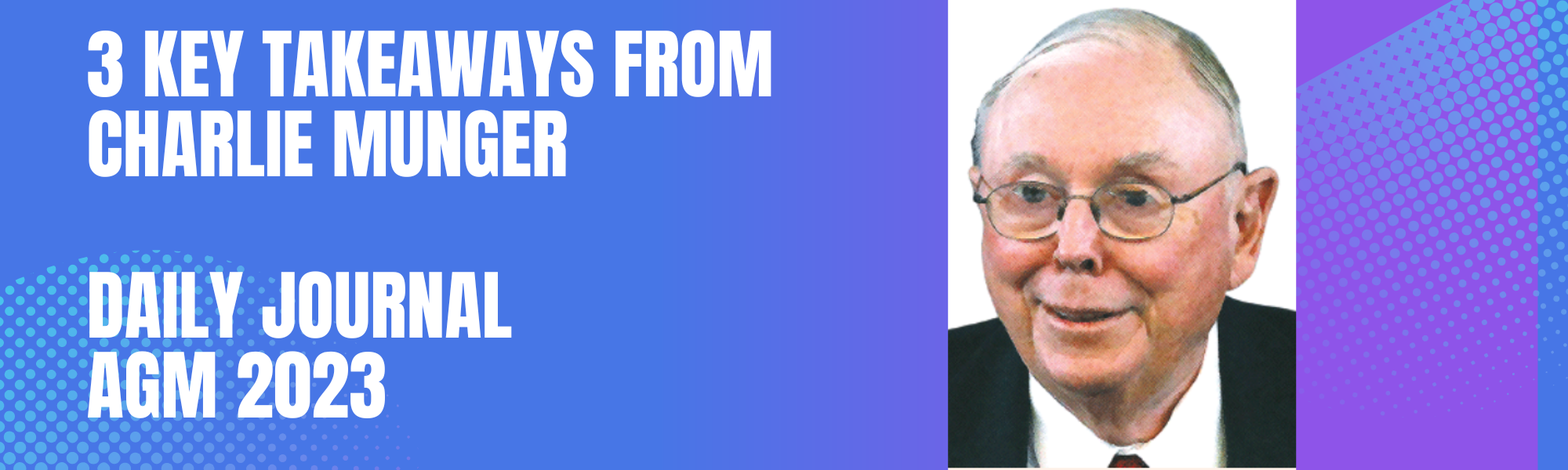
Charlie Munger, the 99-year old Vice-Chairman of Berkshire Hathaway, has a side 'hustle'. Munger is a director (and former Chairman) of a company called the Daily Journal Corporation, which provides case management software to lawyers in the US. Munger, who began his career as an attorney, has been one of the worlds most successful investors ovet the last fifty years. In contrast to most in corporate America, he says things that are worth listening to. Every year, Munger gives a talk at the Daily Journal annual general meeting, and here are three key takeaways from the most recent event.
How to invest your pension monies?
Munger only offers his employees at the Daily Journal the option of investing in index funds through their pensions (401ks). He’s doesn’t give them the opportunity to invest with fund managers.
“look at the Daily Journal Corporation, we just put it in a 401K plan. What are the investment options for the people that work there? Zero options. It’s all index funds. What percentage of American corporations have our plan, with index funds being required? About zero, am I right? Or am I wrong? Of course I’m right. That’s the logical thing to do.
He also comments that he wouldn’t give his money to 95% of professional fund managers in the US.
“You have got to somehow recognise a good business before it’s recognisable as a good business. That’s very hard to do. Some people get good at it, but not many. I don’t think I would want 95% of the people who are America’s professional asset managers working for me. I think it's that hard. I think you need to be in the top 5% to have a reasonable chance, I mean it's that difficult. Now what's not difficult is to buy an index fund and sit on your ass”.
Making mistakes
Munger commented about his investment in the Chinese e-commerce giant, Alibaba. Alibaba is often referred to as the Amazon of China.
“I regard Alibaba as one of the biggest mistakes I ever made,” “In thinking about Alibaba, I got charmed by their position in the Chinese internet and didn’t stop to realize, 'they’re still a gawd-damned retailer.'”
Munger’s initial investment in Alibaba was made in 2021, when he was ninety-seven. He’s known for being upfront when he makes mistakes and is famous for his willingness to learn from them. He previously said -
“I like people admitting they were complete stupid horses’ asses. I know I’ll perform better if I rub my nose in my mistakes. This is a wonderful trick to learn”.
During the annual meeting he also described one of the main factors that prevent us from making good decisions.
“If I had to name one factor that dominates human bad decisions, it would be what, I call denial. If the truth is unpleasant enough, their mind plays tricks on them and they think it is really happening. Of course, that causes enormous destruction of business”.
His greatest investment
If you are a Charlie Munger aficionado, you might expect the answer to this question to be Costco, See’s Candies, or Berkshire Hathaway. Munger does given his investment in the Chinese electric car maker BYD an honourable mention, mainly because his initial investment of $270k is now worth $8 billion. Surprisingly, he believes his best dollar-for-dollar investment was the money he paid an executive recruiter. Munger, takes the story up here -
“ We paid an executive recruiter to get us an employee and he came up with Ajit Jain. The return that Ajit made us compared to the amount we paid the executive recruiter, that was our best investment at Berkshire (Hathaway)”
Ajit Jain is the Vice Chairman of Insurance Operations for Berkshire Hathaway, and has been responsible for ‘pricing’ risk for insurance policies for the last thirty-five years. Jain has been described as a “genius with a sense of humour”, and while Munger mentions the financial benefits of his employment, I suspect the real value is knowing the insurance operations are run properly. In Ireland, the consumer is still paying levies for insurance company failures from the 1980s (PMPA) and 2000s (Quinn Insurance). Having competent people in key positions is good for businesses and good for society over the long-term. I can see why the executive recruitment fee seems low in hindsight.
Contact us today.
 +353 (0)87 344 5882
 info@saolcapital.ie
 Saol Capital, City Quarter, Lapps Quay, Cork T12 Y3ET
Registered in Ireland, company number 682955
Long Strand Limited trading as Saol Capital is regulated by the Central Bank of Ireland
© Copyright 2026 | Saol Capital | Software by REDStudio | All Rights Reserved
Contact us today.
+353 (0)87 344 5882
info@saolcapital.ie
Saol Capital, City Quarter, Lapps Quay, Cork T12 Y3ET
Registered in Ireland, company number 682955
Long Strand Limited trading as Saol Capital is regulated by the Central Bank of Ireland
Sustainable Finance Disclosure
© Copyright 2026 | Saol Capital | Software by REDStudio | All Rights Reserved