

Private market investments are a bit like the Irish actor Paul Mescal. They’re everywhere at the moment! From large firms like BlackRock to Irish wealth managers, private markets are certainly "en vogue", driven by the belief that they will deliver excess returns over the next 10 years.
When you invest in private markets, you are essentially investing in a private company or private debt. The investment is not open to everyone, as it cannot be purchased on a public market, such as a stock exchange.
Investors may face hurdles to direct investing in private investments, including limited transparency and liquidity, as well as increased complexity and costs. But most investors are already getting exposure to private assets through their public investments, even without directly facing those frictions. The reason: public firms traded on a stock exchange invest in private companies all the time, so investing in public firms already entails an allocation to private companies.
How much of an allocation?
Finding a precise answer is impossible, but a report from Dimensional Fund Advisors has tried to estimate the amount using public companies’ accounting statements. Their estimate indicates that, out of the $25 trillion invested in the 20 largest US stocks, investors have about $100–$150 billion in exposure to private investments.
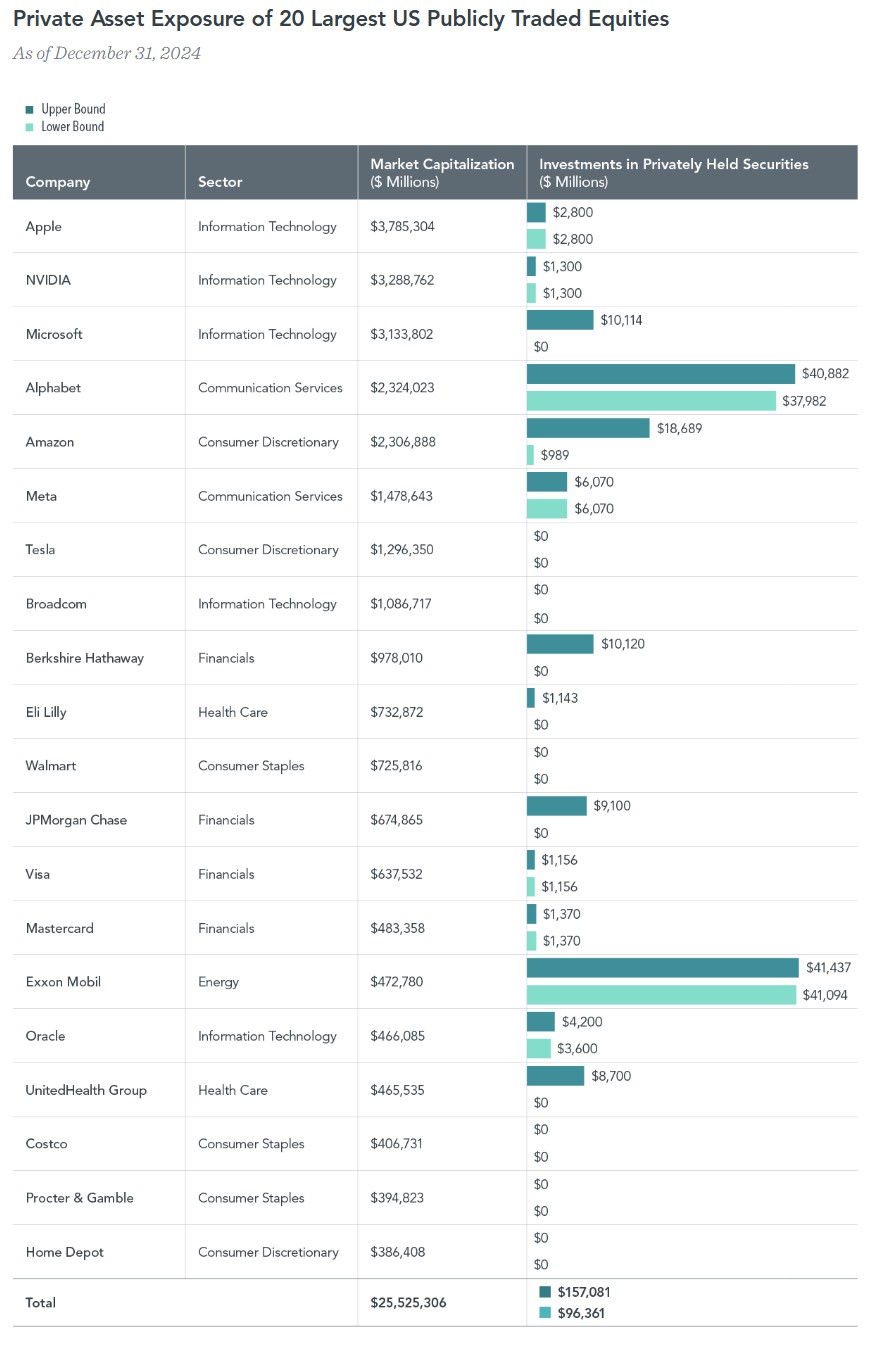
Amazon and Google lead the way
Amazon became a minority shareholder of Anthropic, an American artificial intelligence (AI) startup known for its Claude large language model, by investing $5.3 billion in 2024. Alphabet, Microsoft, and NVIDIA also have minority stakes in Anthropic.
In addition to about $100–$150 billion in direct investments, private investment by a public company could take the form of corporate venture capital (“CVC”). CVCs are prevalent across sectors and have a long history. For example, in 2009, Google Ventures (now “GV”) was launched as an independent venture capital (VC) firm with one limited partner: Alphabet (Google). The private equity firm now has $10 billion in assets under management. By investing in Alphabet, investors indirectly hold a stake in GV and, by extension, in a private company like Stripe, one of GV’s investments. Stripe is well known to Irish investors, having been founded by John and Patrick Collison in 2010.
By holding the top 20 US publicly traded equities, investors also have a stake in NVentures (NVIDIA’s private capital arm), M12 (formerly Microsoft Ventures, a private equity firm and subsidiary of Microsoft), Amazon Catalytic Capital (Amazon’s VC fund), and Lilly Ventures (the global biotech investment arm of Eli Lilly), among many others.
Private asset investment by public companies can take on many forms beyond direct investments and CVC. Again, take Alphabet as an example. The company invests in private firms not only through its CVC but also through its subsidiaries. In 2024, the company invested $350 million in the privately held Indian e-commerce company Flipkart through the Alphabet subsidiary Shoreline International Holdings.
Private Company exposure via the London Stock Exchange
While investing in private markets is popular now, we don’t think it’s necessary to achieve good investment outcomes.
That being said, where a client has significant investment losses, we can structure an investment portfolio that invests in private markets and is subject to capital gains tax. The subsequent investment gains can be offset against historical losses.
Many investment funds (trusts) that are listed on the London Stock Exchange have exposure to private markets and are subject to capital gains tax. The difference with these funds is that they are liquid, that is, they can be bought or sold on a daily basis.
This contrasts with the vast majority of private market investment funds, where interim valuations are subjective and the investment's life can be as long as ten years.
Key Takeaways
- Alphabet (Google), Salesforce, Samsung, Cisco, Qualcomm, BMW, and a host of other companies all invest in private companies, which you own if you are invested in a global index fund. You have exposure to private markets, even if you don’t realise it.
- Smaller private companies may be sold to larger companies, particularly in the Tech sector. The Magnificent 7 Tech companies (Alphabet, Amazon, Apple, Tesla, Meta Platforms, Microsoft, and Nvidia) are behemoths. These large companies control distribution and are laying the foundations of future AI infrastructure (data centres, etc.) – small companies cannot compete with their scale.
- Private market investments are about generating fees for the promoters, not investment returns for the investors. As investment fund fees have declined over the last decade, fund managers are looking for ways to charge higher fees. The opacity of private markets is an ideal environment for this.
- Personalised financial planning, tax advice, asset allocation, and lower fees will always have a greater impact on your own personal financial circumstances than investing in private markets.
 +353 (0)87 344 5882
 info@saolcapital.ie
 Saol Capital, City Quarter, Lapps Quay, Cork T12 Y3ET