

In a rare moment of candor from a major technology chief executive, Arvind Krishna, CEO of IBM, was asked a simple but loaded question by Nicolai Tangen, CEO of Norges Bank Investment Management: Is AI a bubble?
In his response Krishna laid out a methodical, numbers-driven argument that while he doesn't think we are in an A.I. bubble, he believes the capital being spent on A.I. infrastructure is running well ahead of what the market can reasonably absorb — and the arithmetic to support his view is hard to argue with.
The numbers Krishna uses are large, very large. He estimates that every 1 gigawatt of A.I. data centre capacity costs somewhere between $60 billion and $80 billion to build and populate with semiconductors, cooling infrastructure, and power systems. The industry as a whole has now collectively committed to more than 100 gigawatts of A.I. data centre build-out globally. Multiply that out and you are looking at total planned capital expenditure of somewhere between $6 trillion and $ 8 trillion. Goldman Sachs has separately estimated $7.6 trillion in aggregate A.I. capital expenditure (see below) between 2026 and 2031, so his numbers are reasonable.
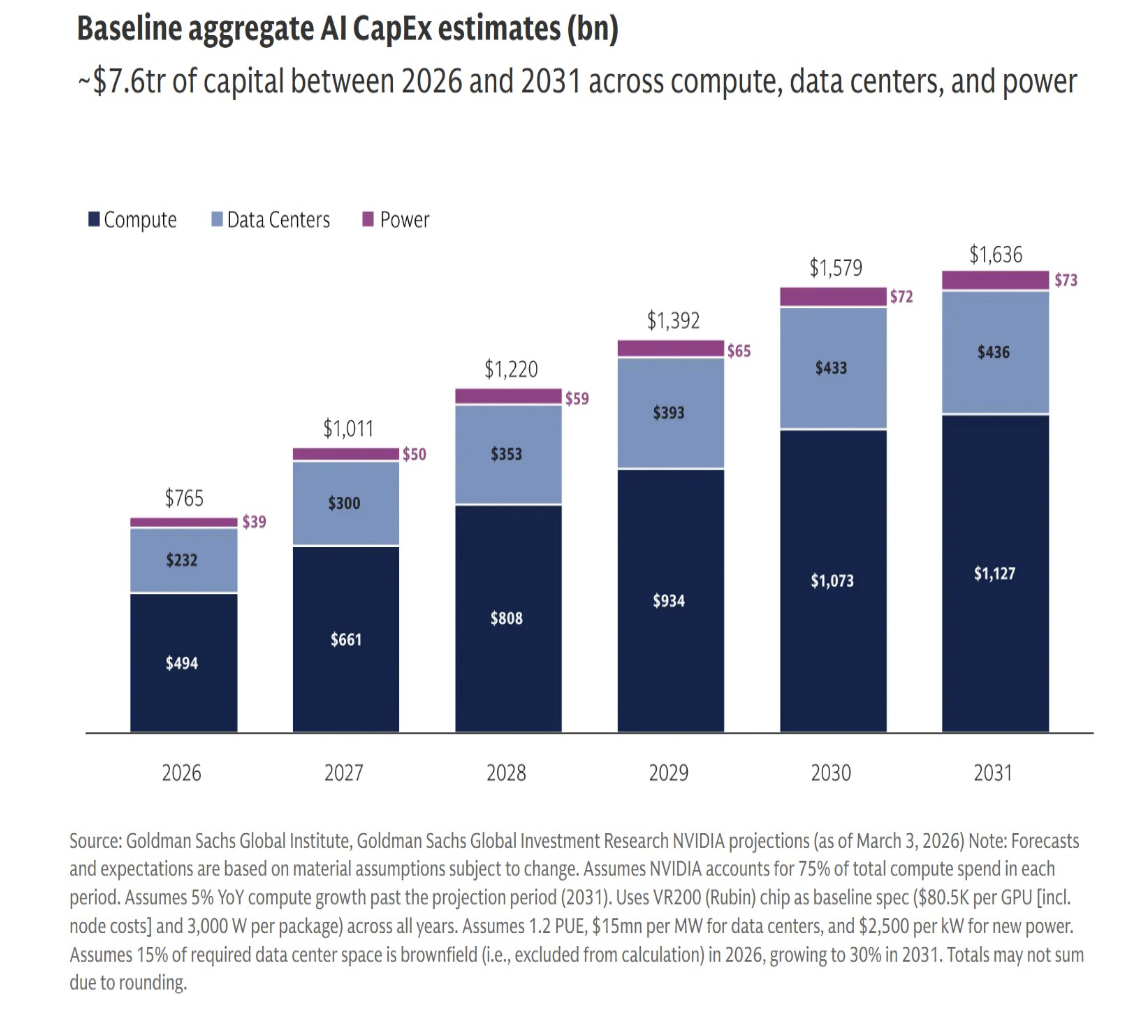
The problem is not the size of the investment in isolation — it is whether the returns can plausibly justify it. A.I.-grade hardware typically depreciates on a five-year cycle, which means the entire capital base needs to be effectively replaced within that time period. So Krishna's point is that he thinks that too much is being invested too soon, and that some components of A.I. (the chips like GPUs, ASICs, etc.) will need to be replaced within five years. Other infrastructure like the physical data centre typically last twenty to twenty-five years. So, we may have a situation where improvements in technology, which drive greater efficiency leads to more hardware (chips) being replaced earlier. His bottom line is that the capital expenditure of $6-$8 trillion requires somewhere between $1–2 trillion in additional annual revenue to justify the investment — and even at high margins of 20–30%, the numbers don't stack up in his view.
What happens if there is an A.I. overbuild?
Krishna believes that the pay back from these projects will be lower than people expect. He also mentions that the larger A.I. models will become commodity products. This is good news for consumers but bad news from the companies behind them. If you produce a commodity-like product; the low-cost, high volume producer typically wins (think Ryanair). The larger tech companies (Google, Microsoft) with large distribution networks to clients will benefit, but they will not generate above average profits. Krishna thinks that the infrastructure capital that is being deployed is based on speculative assumptions rather than proven demand.
He gives the example of the fiber optic overbuild in the US in the late 1990s. Dozens of companies went bankrupt laying cable that nobody was using, and yet that "wasted" infrastructure became the physical backbone of every cloud company, streaming service or mobile network that followed. Today's large tech companies will not have the same exposure as the companies in the 1990s as much of the financing for data centres has been arranged via joint ventures, in so-called special purpose vehicles.
A.I. Overload?
The legendary investor and founder of Vanguard, Jack Bogle, once said that when it comes to predictions, "Nobody knows nothing". That being said, investment analysts and fund managers try to discount the future and predict the future of A.I. These "guestimates" will then be represented in the stock makret. When it comes to A.I. one of possible outcome is that the resources to build these data centres will encounter physical bottlenecks; a lack of electrical grid connections, cooling infrastructure etc, which means that a large amount of the planned data centre projects will be cancelled or delayed before they ever start. At this point, this would be a healthy outcome for stock markets.
 +353 (0)87 344 5882
 info@saolcapital.ie
 Saol Capital, City Quarter, Lapps Quay, Cork T12 Y3ET