

Geopolitical events can be unsettling and have a short-term impact on markets. James Carville, who advised Bill Clinton on his 1992 presidential bid, once said “It’s the economy, stupid” when advising him what to focus on during his campaign. In financial markets, the decline in company earnings has the greatest impact in the medium term. So, when looking at markets, “It’s the earnings, stupid”. Geopolitics have an impact, but it is generally short-lived.
A quick question – Take a look at the geopolitical events below. Which event do you think had the most lasting impact on your day-to-day life?
1. The Cuban Missile Crisis (1962)
2. First Oil Shock (1973)
3. The Vietnam War (1955–1975)
4. The Fall of the Berlin Wall & USSR Collapse (1989–1991)
5. The 9/11 Attacks (2001)
6. China's Economic Opening (1978-present)
7. The Gulf War (1990–1991)
8. The Iraq War (2003)
9. Russia's Invasion of Ukraine (2022-present)
I think there were two Geopolitical events that had a lasting impact on our day-to-day lives. The first was the opening up of the Chinese economy, where the then-leader Deng Xiaoping declared, “Get rich is glorious”. The transition to capitalism caused massive downward pressure on goods worldwide. Think everything from solar panels to childrens toys to electric vehicles. If you have teenagers in your house, I am sure you are sick to the teeth of deliveries from Shein and Temu!
The second geopolitical event that has implications today was the Vietnam War. In 1971, President Richard Nixon ended the direct convertibility of the US dollar into gold, terminating the Bretton Woods system, which was established after World War II. This move was taken to fund the Vietnam War and to combat inflation. It shifted the world to a fiat currency system, which we have today. The outcome of this decision is that governments can borrow much more money. This has led to governments, particularly since the early 2000s, to borrow to fund day-to-day expenditure.
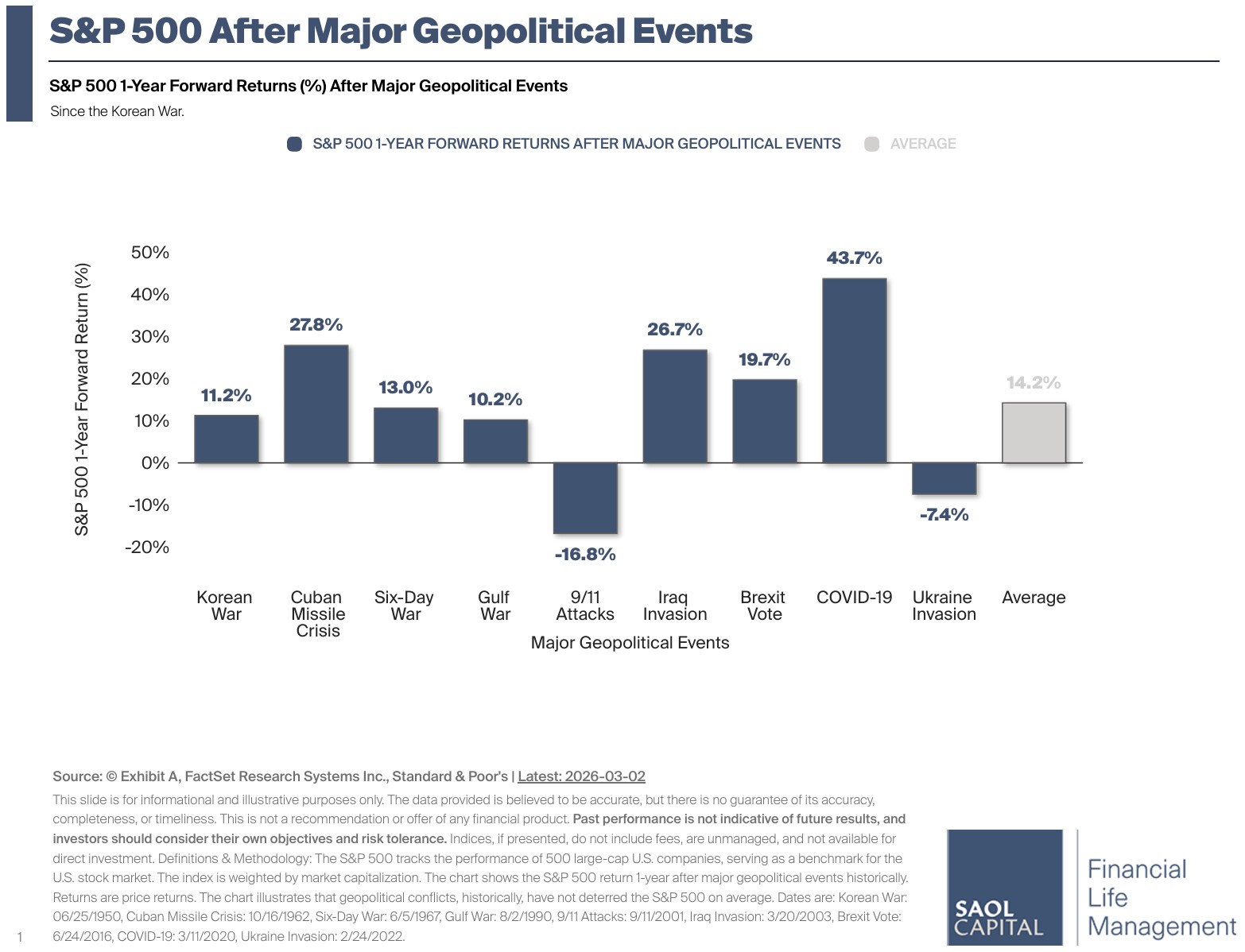
How do Geopolitical impact the stock market?
The chart shows the performance of the S+P 500 after major geopolitical events. The only large decline I believe should be attributed to a geopolitical event, but is not listed in this chart, was the first Oil embargo in 1973. The stock market declined by -48% as oil prices quadrupled overnight. The world economy was very different in the early 1970s, with oil used throughout the economy. Today, the US is a net energy exporter, and China is not as reliant on oil as it was even five years ago.
What if I invest at the ‘wrong’ time?
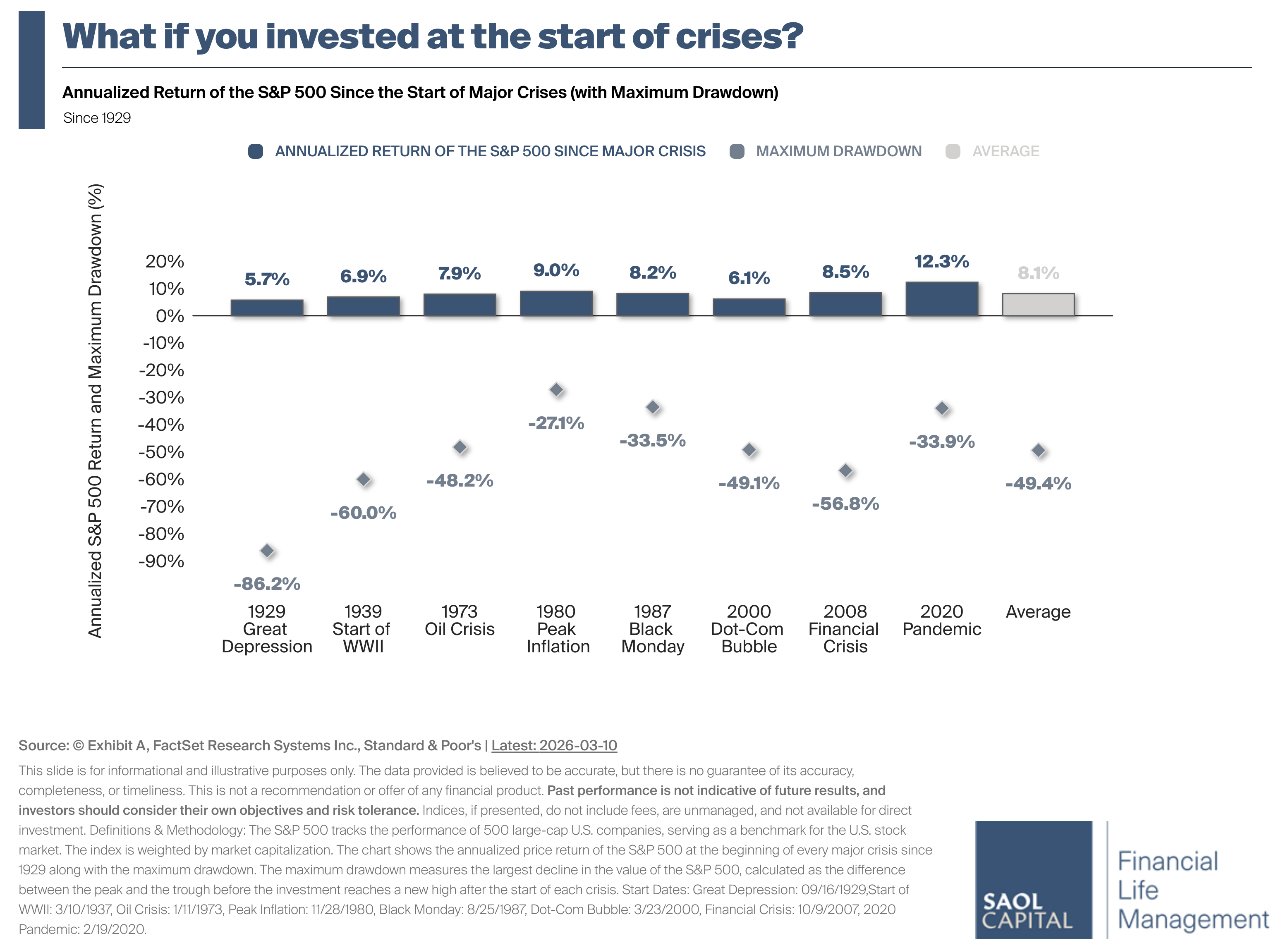
Geopolitical events are outside our control. That said, it is important to remember that, in any given year, the likelihood of the stock market rising is 70%. Let’s say you invested at the ‘wrong’ time just before a financial crisis. How did you fare?
The good news is that if you continued to hold your investment through the declines, you received the average annual return of between 6%-8% over the long term.
Postscript:
With all the gloomy news in the world right now there are lots of exciting developments that do not make the front pages. A.I. and the possibility of job displacement are hot topics today, but A.I. is also transforming medicine. The BBC reported that a study led by the University of Aberdeen on 10,000 women, found that breast cancer detection can be improved by more than 10%. The AI tool, called Mia, can flag small, hard-to-spot areas of concern on mammogram scans that the human eye might miss. Widespread medical trials using A.I. have only been carried out over the last two/three years. The speed and cost of early detection should only increase over the next decade.
 +353 (0)87 344 5882
 info@saolcapital.ie
 Saol Capital, City Quarter, Lapps Quay, Cork T12 Y3ET